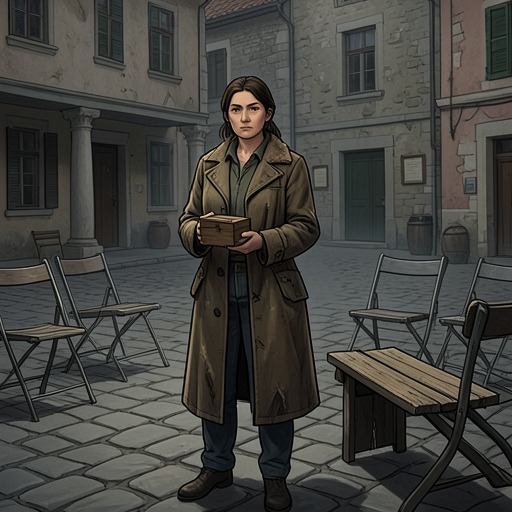
Zinaida Yevdokimovna Kovalenko
Voices from ChernobylZinaida Yevdokimovna Kovalenko, identified in the book as a re-settler, remains in a village emptied by evacuation, where the dead are near, the living are far away, and the consequences of radiation are both unseen and, in her account, startlingly visible. Her testimony does not treat the abandoned place as merely a ruin: it is home, a cemetery, a garden, and a habitat shared with animals. Staying there becomes a way of holding fast to the life she has lived and bearing witness to what was left behind.
Identity and attachment to home
Zinaida has spent seven years alone since the people left. At first, she expected them to return; no one had said that their departure was forever. Over time, waiting for the villagers gave way to waiting for death. She describes death as the one impartial thing in an otherwise unfair world: she had worked honestly and hard, yet felt that fairness had passed her by. The thought is not an abstract meditation. In the deserted village, with no church and no priest to hear her confession, death is a daily presence and a prospect she finds frightening even as she accepts its inevitability.
Her children are in the city, but she refuses to join them. She knows that old people can try the younger generation’s patience, and she has not found much joy in her relationship with her children. She describes her daughters as unhappy in the city and wanting to come back. More decisive still is the fact that her husband, Fedya, is buried in the village. If he were alive, she says, he would live somewhere else and she would be with him; because he is buried here, leaving would mean leaving him. Yet her attachment is not only to the graves. She insists that the place is beautiful: things grow and bloom, and life extends from the smallest fly to the animals.
Radiation and the evacuation
Zinaida remembers being told that radiation lay on the ground and entered it, though people could not see it. Her own account challenges that invisibility. She says she saw pieces of cesium in her yard: one ink-black and breaking apart in the rain, another blue, and another farther away. She and other women searched the gardens and a nearby field of about two hectares, finding roughly four large pieces, including one red fragment. After rain, the pieces were gone by lunchtime the next day. The claim that radiation was invisible had not prepared her for what she believed she had seen; once she had seen it, she says, she was less afraid.
The official instructions seemed to her at once alarming and absurd. Police and soldiers posted signs by houses and in the street giving readings of 70 or 60 curies. Residents who had lived on their own potatoes were told not to eat them, advised to work in gardens wearing masks and rubber gloves, and instructed to wash their yards and household linens. Wells were closed, locked, and wrapped in cellophane because the water was said to be dirty. Zinaida could not reconcile these orders with the clean-looking water, or with the insistence on washing sheets stored behind closed doors while contamination remained in the forest and fields. Her disbelief coexisted with fear: as people began packing at night, she gathered her clothes, her red badges for honest labor, and a lucky kopeika.
She also recalls hearing that people in another village had hidden with their cows in the forest when soldiers came to put them on buses, as villagers had done during wartime village burnings. The comparison makes evacuation feel less like a safe departure than a renewed displacement. Zinaida says that on the first day she did not leave her house. Later, she heard of a column of people walking beside a column of livestock. To her, it looked like war. Some of the young people who left had already died in their new homes, while she was still walking in the village, though more slowly. The deserted streets and the birds and elk around them mark the strange aftermath: she has survived there, but the human community that made it a village has gone.
The animals left behind
When everyone left, they left their dogs and cats. In the first days, Zinaida carried milk to the cats and bread to the dogs, which waited in their yards for their owners to return. The cats eventually ate cucumbers and tomatoes. She continued caring for a neighbor’s lawn up to the fence and hammered the fallen fence upright again. She even spoke to the neighbor’s dog, Zhuchok, asking him to call out if he saw the people first. Her small acts of care keep the absent neighbors present, while the animals’ waiting gives a living form to the hope she once shared.
That care does not make the village’s animal life gentle. During a winter when rats attacked and got under the covers, her cat Vaska saved her; rats had also made a hole in a barrel of grain. Zinaida and Vaska talked and ate dinner together. When the cat disappeared, she did not know whether hungry dogs had eaten him. Those dogs eventually died, and some cats, driven by hunger in winter, ate their kittens. The scene places companionship beside brutal deprivation without turning either into a simple symbol: animals are her companions, but they are also vulnerable lives struggling in the abandoned settlement.
Even after so much loss, she does not drive away the crows. When a little rabbit came by, she invited the one woman living in a nearby village to visit, hoping that company might help. Human conversation has become scarce, so the presence of another person matters even when it may not cure loneliness. At night she sometimes hears, or dreams of hearing, a neighbor call her name. The voice comes and then falls silent, like the village itself: remembered as inhabited, experienced as empty.
The village of the living and the dead
Zinaida goes to the cemetery, where her mother, her husband, and her little daughter are buried. Her daughter died of typhus during the war. Zinaida remembers that, just after the child had been buried, the sun came out from behind the clouds and shone so insistently that it seemed to call the child back. In solitude, she sits with her dead and talks to them as she would talk to the living. She does not treat the distinction as decisive: when a person is alone and very sad, both kinds of conversation can be heard.
The cemetery also gathers the village’s histories. Zinaida recalls a teacher who moved to Crimea to be near his son, a tractor driver remembered for his skill at making lace out of wood, and other neighbors whose houses stood near the graves. When the tractor driver’s large house was torn down and buried as contaminated, an officer shouted that it was on a hot spot while drunk. Zinaida remembers the house’s destruction as a personal wound, and remembers the owner crying as she was sent away. Another neighbor left and died soon afterward; another man’s house burned at night, and he too did not live long. Her account turns demolition and departure into losses attached to particular people, homes, and remembered skills.
She contrasts the village’s past holidays, when people sang, danced, and played the harmonica, with its present desolation, which she likens to a prison. Yet when she closes her eyes and walks through the village in memory, she finds the signs of life again: a butterfly, buzzing bees, and Vaska catching mice. The remembered scene does not cancel the destruction; it shows what the empty place still contains for her. Her account holds the ruined houses, graves, living creatures, and recollected festivities in the same emotional landscape.
Bearing witness
The monologue’s movement between practical detail and grief gives Zinaida’s testimony its force. She speaks of readings on warning signs, wrapped wells, stored linens, a fallen fence, a lucky coin, and the animals’ hunger; she also speaks of unfairness, loneliness, and the dead. The ordinary objects do not make the disaster ordinary. They show how it entered the yard, the pantry, the cemetery, and the routines of caring for a neighbor’s property.
Near the end, Zinaida addresses Lyubochka directly and asks whether she understands the sorrow being entrusted to her. She hopes it will be carried to other people, even if Zinaida herself is no longer alive, buried beneath the roots. That appeal recasts the solitary speaker as a witness speaking beyond the deserted village. She has refused to leave the place where her husband is buried, but she also asks for her account to travel outward: the testimony is the connection she can still make between the abandoned home and the living audience.